Showing posts with label Bible. Show all posts

Tuesday, 28 May 2013

Ten years on...


(A personal reflection)
Last month was a significant milestone for our family.  It was the 10th anniversary of an event which changed our lives forever.
On the 4th April 2003, at about 9:30am, my wife Mel was cycling to Yoga through the busy streets of Brixton when a lorry turned left without looking or signalling, and she was dragged under its wheels.  She was pushed down the road under one of the front wheels for about 10 metres and when the 18 tonne truck came to a halt, it was quite literally resting on top of her pelvis.

Those who know us or our story, will know that by some miracle she survived, but it led to month after month in hospital after hospital, and on a number of occasions she was at real risk of dying, even years after the accident.  Today she is partially disabled, suffers chronic pain, and has to take tablets by the handful two or three times a day.

As you can imagine, the impact on our lives was dramatic.  For Mel, the effects are obvious:  pain, disability, loss of identity, depression and the side-effects of all the drugs have taken their toll.  Instead of looking forward to returning to work when both kids went to school, she had to limit her ambitions to learning to walk, time and time again, and staying out of a wheelchair for as many years as possible.
Our children were just 3 and 4 years old when the accident happened.  Zac was settled in the reception class at school but Iona was still at home with Mel looking after her as a full time stay-at-home mum.  Mel was just beginning to loosen the apron strings taking her to a play-group while she went to Yoga.  She always left with the promise “Mummy always comes back”.  For both the kids, the change was enormous, going from mum always being there, to seeing her in hospital for a few minutes every other day because she was simply too ill for anything more.

But for me too, the change was greater than I could have imagined.   I was vicar of a busy parish in Brixton, London.  As well as leading the church, I was also responsible for overseeing several projects including a ‘Foyer’ homeless project, employment training company, charity shop, cafĂ©, and youth team.  I was a member of the Church of England’s General Synod and an adviser to the Government on urban regeneration.  I had co-written a resource book on ministry in run-down housing estates and was getting invitations up and down the country to speak to groups of church leaders.
Slowly, one by one, all these things were stripped away as I found I simply couldn’t keep up with my working responsibilities alongside being mum and dad to the kids, supporting Mel in hospital and caring for her at home, and dealing with my own sense of spiritual brokenness.  “Why did you let this happen, Lord?  We were constantly sticking out our necks for you – couldn’t you have watched our backs?”

First to go were the speaking engagements and promoting resources for estates ministry.  I had spent 7 years developing the resources which went into the book, but now I found myself having to say no to invitations to help others use them.
The work with the Government went next as I simply couldn’t attend the residential meetings up and down the country.  I had been one of 20 people selected out of 600 applicants to serve on this national Community Forum, but now I found myself having to tender my resignation.

Then I had to scale back on the local projects I was overseeing, even though many of them were fragile and at a critical stage.
And my work at General Synod (the Church of England’s parliament) slowly became too difficult to do.  I could only attend about half the meetings, and even then had to miss things because of last minute complications, or a sudden downturn in Mel’s condition.

Then finally, 18 months after the accident, after Mel had survived another series of major operations, my health failed.  A combination of exhaustion and PTSD finally caught up with me and I was signed off work by my doctor.  For the first few weeks, I found myself unable to answer the door, pick up a phone or switch on a computer.  When I left the house to take the kids to school, or take Mel to her many out-patient appointments, I could hardly speak to people, except in one-word answers.
Soon we realised that we had to leave London and find somewhere quieter to live – somewhere where we could both heal.  We had been totally committed to living and working in the parts of London where others choose not to go because of poverty, crime or violence.  We never thought we would do anything else, but now we found ourselves moving to the other extreme – a sleepy village in comfortable, rural middle-England.  The stripping away of my previous sense of Christian calling, ministry and vocational identity was now complete.

But in all the trauma and exhaustion, there is one thing that we will always be grateful for.
I now see that for years before that fateful day, God had been challenging my sound, traditional, conservative theology of sexuality. 

Just like Peter on the roof of Simon’s house in Joppa, he had been challenging my perceptions of what was clean & unclean in his eyes, time & time again (see Acts 10) and just like Peter, I had refused to listen.    I had stuck to what I had been taught.  I had remained steadfast in the ‘Biblical’ teaching I had received since my childhood.  I had repeated the conservative evangelical mantra, “The Bible says its wrong” over and over again when it came to same-sex relationships.  I had signed letters to the Church of England deploring any relaxation in this strict moral code.  I had told gay friends who were ordained that I thought they should leave their ministry if they refused to repent and amend their lives.
But then in the brokenness which followed Mel’s accident, God gently lowered the sheet once again, sending to me gay Christians who tended my wounds – who prayed with me and for me when I couldn’t pray – who held me close to Christ when all my spiritual strength was gone.

And when I went back to the Bible to look again at what it said about such people, I found that the blinkers had gone.  The same blinkers which Peter wore when he said “No Lord” – the blinkers which meant that, when I went to the Bible, I already knew what it was going to say, even before I read it.  Those blinkers were gone, and for the first time I saw how weak the Biblical case was for condemning same-sex relationships.
Like the scales which fell from Paul’s eyes after his conversion on the road to Damascus, I now could see properly for the first time, and the world looked very different.

The rest, as they say is history.
The new understanding which came out of our tragedy has taken me down roads I never could have imagined.  I remember sitting in a Communion service at an LGB&T conference recently and feeling more at home than I do in most churches.  My wife and I have been able to talk about her Bisexual orientation – something we both knew, ever since we met, but had never been able to be talk about – and we are closer than ever as a result.  Our children live in a family where there is no conflict between faith and sexuality and their faith has flourished.  Even as teenagers, they are the ones who look disappointed if Mel or I say we can’t go to church this week.

So was this all part of God’s plan?
No – I can’t say that – but I do know that God promises to bring good out of even the darkest situations, and we have been blessed by the good He has brought into our lives despite all the pain.

Sometimes it is only when we are broken that God can work to reshape our lives.  That brokenness can come from our own actions, or the actions of others, or even from random events at work in our world, but God can use even the greatest tragedies to open closed hearts to his love.
I am only sorry that I was so stubborn and hard of heart when God’s sheet was being lowered down to me before Mel’s accident – and that it took such a traumatic event to change my mind.  My prayer for others, who struggle with this issue, is that it will not take such a tragedy to open their hearts to a new understanding of God’s will.

As this 10th Anniversary has passed, Mel and I still struggle with depression, flashbacks and the on-going effects of that terrible day, which is partly why I have been so quiet recently.  But in Christ we are more than conquerors through him who loves us and we are profoundly grateful for the good that he has brought out of the evil of that day.

Wednesday, 13 June 2012

Were the Patriarchs really married ?

“Marriage as created by God is an exclusive relationship between one man and one woman that is entered into for life …”

So says the St Matthias Day Statement from the Church of England Evangelical Council and the Church of England’s official response to Government proposals for same-sex marriage.  The Archbishop of York agrees.  “Marriage is marriage is marriage” he states, and “neither the State nor the Church, or any religious group can change the essential nature of marriage”.

But that evokes a curious question in my mind – in that case, were some of the most prominent marriages in the Old Testament really marriages at all?
The question arises, of course, because most of the famous marriages in the Old Testament were not ‘an exclusive relationship between one man and one woman’.  Therefore, according to the CofE and the Archbishop, they were not marriages at all.

Let’s take Jacob for example.  He worked for Laban for 7 years to ‘earn’ the hand of Rachel in marriage.  But when Laban deceived him and married him off to her sister Leah, he worked for another 7 years to get the bride he really wanted as well.  He married two sisters, and it didn’t stop there - he also had children with Rachel and Leah’s servants.  Were these marriages in the sight of God?  These ‘marriages’ were not exclusive relationships between one man and one woman as created by God.   And what about the children which resulted?  Even if we accept Jacob’s first marriage to Leah as the one that really counts, that means that 5 of the tribes of Israel were born outside of wedlock, as a result of nothing less than institutionalised adultery.
Perhaps Jacob can be forgiven because at least he came before the Law was revealed to Moses on Mount Sinai.  Surely this pivotal point in God’s relationship with humanity would put all that straight.  Indeed it did include some regulations on divorce, but no definitive statement or definition which would put the matter rest once and for all.

Then there were David and Solomon, both heroic Kings of the Old Testament, and both of whom were married many times over.  David appears to have had at least 8 wives (and many more concubines) and yet he wrote some of the Bible’s most moving Psalms extolling the Word of God.  Could these really be marriages?  Apparently not, according to the Evangelical Council!  Solomon had 700 wives and 300 concubines according to 1 Kings 11 and the only rebuke which Scripture offers is that many of them were foreigners.
Indeed the relationship between David and Solomon is problematic in the extreme as Solomon was David and Bathsheba’s child - and we all know how that relationship began.  David committed adultery with Bathsheba (Uriah’s wife) and then had him killed in battle when Bathsheba found she was pregnant.  Surely David and Bathsheba’s marriage could not be valid in the sight of God – nor could Israel or the Levites make it a ‘marriage’ because “marriage is marriage is marriage” and “neither the State nor Church can change it” from that which was “created by God” as “an exclusive relationship between one man and one woman that is entered into for life”.

So what is the point of all this?   Am I really advocating polygamy as a Biblically valid form of marriage?  Or arguing that we should re-define marriage to be more ‘biblical’ in this sense?
No – I am not!

What this does show however, is the limitation of trying to give eternal status to our current definition of marriage and claim that it is, and has always been the created will of God.
In fact, there is no normative example of marriage in Scripture that ends the story once and for all.  Even Adam and Eve cannot be claimed as such, as their story is meant to be figurative rather than literal.  (Otherwise we open up yet another can of worms as we have to concede that their children must have married each other, thereby opening up the possibility of incestual marriage as well!)

If ‘marriage is marriage is marriage’, and cannot be any different to our current definition, then most of the people in the Bible were not married, their children were born out of wedlock, and all sexual activity in those ‘non-marriages’ could not have been blessed by God because they were sinful, pure and simple.
The alternative is to recognise that our understanding of marriage has changed over the centuries and continues to change.  Whether it is the slow transition to monogamy, or the marriage of slaves, or interracial marriage, or the continual tension between marriage and divorce, we have continually amended our understanding of what does and does not constitute marriage in the sight of God.

In these areas the church universal has never been unanimous in its attitudes or practise, and if we want to look biblically at marriage (which I hope we do) we have to recognise that God appears to have been far more willing to embrace different forms of marriage than the church of today. 
We also need to delve much deeper into Paul’s ultimate paradigm for marriage.  The marriage of Christ and his bride, the Church is a marriage which is not dependant on gender or sex, and which is expressed in the substance of the relationship, rather than the correctness of the formula (one man + one woman = Marriage).

In the end, all definitions and understandings of marriage through history have been temporary and will remain temporary this side of eternity.  It was Jesus himself that said, “The people of this age marry and are given in marriage.  But those who are considered worthy of taking part in the age to come and in the resurrection from the dead will neither marry nor be given in marriage… for they are like the angels.” (Luke 20:34&35).
It is time we acknowledged the temporal nature of our limited understanding and looked for marriages which are life-giving relationships based on the vows and promises which the marriage partners make to each other, rather than the gender of the partners. 
When the woman at the well challenged Jesus on the correct place to worship God, he told her that the time was coming when God’s true worshippers would not be tied to one place, but would worship God ‘in Spirit and in Truth’.

Once again, perhaps, we need to look beyond our limited views and disagreements to marriages which are grounded ‘in Spirit and in Truth’.  For there we will find God.

Monday, 19 March 2012

Can you change marriage ?

When the Government published its much awaited consultation on same-sex marriage last Thursday, the battle lines had already been clearly drawn.

On one side are the Prime Minister, gay pressure groups, and the majority of MP’s in parliament  who, according to all calculations, would back such a measure in a free vote.
On the other, ranks of church leaders from a range of denominations who have denounced the proposed ‘re-definition’ of marriage as, in varying degrees, grotesque, dictatorial, and shameful.

A common assertion among the latter is that you simply can’t change marriage.  Marriage is what marriage is, and no-one has the power to alter it – not government, nor church nor equality activists.   According  to the Archbishop of York, it is not "the role of the state to define what marriage is.  It is set in tradition and history and you can’t just [change it] overnight, no matter how powerful you are."
The Archbishop is undeniably right of course, when he points to our current understanding of marriage as "a relationship between a man and a woman" but what he fails to acknowledge is that definitions, understandings and laws relating to marriage have been constantly changing through human history, biblical history, and church history.

If we go back to the Bible, we find that for the bulk of biblical history, marriage was polygamous with many wives equating to male power & success.  Neither the Gospels nor the Epistles ever put a formal end to this model of marriage and yet it is one which few would advocate today - our understanding has changed dramatically from the examples of scripture.
In pre-Enlightenment times marriage was more about property than about love, with political order and social standing high on the agenda for budding brides, grooms and their families.

In the Prayer Book the reasons for marriage are clear - first for procreation of children, then as a remedy against sin, and then finally for the mutual 'help and comfort' of the couple – little about love here.   Brides were ‘given away’ from one man to another. Marriage between family members which were forbidden, included a prohibition on marrying your wife’s sister after her death.  This came from a mistaken understanding of consanguinity – that because you became one flesh with your wife, so you shared the same family blood with her sister.  So strong was this belief that when an act of Parliament finally legalised such marriages in 1907, clergy were permitted to refuse to conduct them - an interesting parallel in today's debates about same-sex marriage.
Today’s theology of marriage can be found more in the modern marriage service of Common Worship than in the Prayer Book.  Here we find the Prayer Book introduction substantially re-ordered and changed.  Marriage is first and foremost about enabling two people to be 'united with one another in heart, body and mind' as they 'grow together in love and trust'.  Then it is for the 'delight and tenderness of sexual union' within 'joyful commitment to the end of their lives' and after all that, it is the 'foundation of family life in which children are [born] and nurtured'. Even here, the square brackets reveal a changing recognition of more complex realities in the raising of children.

So when those opposed to same-sex marriage claim that you can’t just change marriage, it is a selective view of history at best because clearly it has been changed time and time again.  The real issue must be about the substance of marriage and whether same-sex relationships can be embraced within that essence.
Many people in the church and wider society have recognized the marks of marriage in committed  same-sex relationships around them.  Bishop Nicholas Holtam referred to these recently when he said, “I think same-sex couples that I know who have formed a partnership have in many respects a relationship which is similar to a marriage and which I now think of as marriage.

Indeed, when David Cameron asserts that he supports same-sex marriage because "society is stronger when we make vows to each other and support each other", he is echoing the modern marriage service when it affirms that marriage "enriches society and strengthens community."
And there are several pointers within Scripture which might direct us towards an understanding of marriage which is not dependent on gender difference.

When God sought to provide a suitable companion for Adam in the Garden of Eden, he said “It is not good for the man to be alone”.  Gay, lesbian, bisexual and transgender people exhibit the same yearning as Adam.  Just because they find that the person who completes them is of the same sex, that does not abrogate the need which God meets in the creation of another human being to complete Adam’s yearning for a suitable companion in life.
In imagery of the Church as the Bride of Christ (often quoted as a justification for opposing same-sex marriage) we easily forget that the Church comprises both women and men who will, in some sense be a bride to Christ as part of His Church.

In Galatians, Paul calls us to a radical new reality in Christ as gender becomes irrelevant in Christ who enables us all to be born again into a new creation.
As the Government consultation begins, we need to grapple with these issues.  We need to engage in theological debate and prayerful reflection, rather than knee-jerk reactions claiming eternal authority for an institution which is incapable of change.

The role of the Established Church is not simply to act as a line of last defense, but to guide our nation in examining our understanding of God and society.  Marriage is not an immovable object - the question is what direction should it take today?

Friday, 3 February 2012

God, Marriage and the State

With the Archbishop of York firing a first shot across the bows of the Prime Minister over same-sex marriage last weekend, there is a theme emerging from opponents of the idea -  the premise that you can't change marriage.

According  to the Archbishop, it is not "the role of the state to define what marriage is. It is set in tradition and history and you can’t just [change it] overnight, no matter how powerful you are."
The Archbishop is undeniably right of course, when he points to our current understanding of marriage being "a relationship between a man and a woman" but what he fails to acknowledge is that definitions, understandings and laws relating to marriage have been constantly changing through human history, biblical history, and church history.

If we go back to the bible, we find that for the bulk of biblical history, marriage was polygamous and many wives were a sign of male success.  Jesus never openly put an end to this model of marriage and yet it is a model which few would advocate today - our understanding of marriage has changed dramatically from the examples of scripture.
Then there are those family relationships where marriage is forbidden in the Book of Common Prayer.  Few people are aware that they have changed over the years.

My grandfather married his wife's sister after being widowed despite this being forbidden in older copies of the Prayer Book.  From a theological understanding of marriage, the practise of a man marrying his wife's sister was considered wrong under Canon Law, and was formally prohibited by parliament in the 1835 Marriage Act.  It soon became a matter of some controversy.  An attempt to revoke this law in 1842 was defeated by strong opposition, and it was not until 1907 that the Government finally permitted such marriages in the 'Deceased Wife's Sister's Marriage Act'.   The issue was still so controversial that individual clergy were permitted to refuse to conduct such marriages - an interesting parallel in today's debates about same-sex partnerships. 
So when the Archbishop asserts that it is not for the state to define the scope of marriage, it is a selective view of history at best.

Divorce and remarriage is another example.  Civil marriage after divorce has been widely available in England since the 1857 Matrimonial Causes Act and further widened in 1937 and 1969.  Yet it was not until 2002 that the Church of England embraced a clear policy which formally allowed marriage in church after divorce.  Once again the understanding and practice of marriage in law has changed with the church lagging behind the decisions of the state.
But perhaps the most shocking examples of changes in beliefs about marriage come from elsewhere in the world.  In the United States laws against interracial marriage, underpinned by traditional Christian teaching, were still in force until 1967 when a landmark case at the Supreme Court finally declared them unconstitutional.  The case was brought to challenge the conviction of Mr and Mrs Loving, who were dragged from their bed in the middle of the night after crossing the state border to get married in more liberal Washington DC.

The judge who sentenced them to a year in jail famously declared that God created the races and placed them on separate continents which "shows that he did not intend for the races to mix".
Such ideas about race and marriage are hard for us to understand today but they were deeply held and underpinned by theological argument.  This theology of race and marriage has its roots in the preaching of church leaders who opposed the abolition of slavery.  Theologians like Robert Lewis Dabney truly believed that the abolition of slavery was the first step to 'amalgamation' which he described as a 'abhorrent' word. As far as he was concerned the mixing of races was something which the Bible forbade and such marriages should be prevented at all costs.

Nor are such beliefs dead and buried in US churches today.  As recently as December last year, Gulnare Free Will Baptist Church, in Kentucky, voted to prevent interracial couples from becoming members or taking part in any services.  The Pastor of the church said, “I am not prejudiced against any race of people, have never in my lifetime spoken evil about a race... I do not believe in interracial marriages."

So whose role is it to define marriage?  Is it really the Church in all its conflicted diversity?  Is marriage really 'set in tradition and history' as the Archbishop of York believes, even when history shows a continually changing landscape in both spiritual and temporal spheres?  Is marriage really an area where the state has no jurisdiction, despite evidence to the contrary?

What we need in the Church of England is theological debate and prayerful reflection on the nature of marriage, rather than knee-jerk reactions to government initiatives.  At the present time, the debate is almost entirely sociological and political, which is why the church is getting left behind.  Our theology of marriage has changed over the centuries and this is the next change we need to consider.

Perhaps that debate should start with the words of Mildred Loving whose legal challenge finally legalized interracial marriage in the USA.  "I think marrying who you want is a right no man should have anything to do with. It's a God-given right,"

Tuesday, 18 October 2011

An eye for an eye?


Today the Israeli soldier Gilad Shalit was returned to Israel after 5 years captivity in Gaza. 

This single Israeli was set free by Hamas in return for 1,000 Palestinian prisoners released from Israeli jails and some have questioned the size of the ransom which has secured his release.
Certainly 1,000 Palestinians in return for one Israeli appears disproportionate to some Israelis, even after his 5 year ordeal, and Hamas are portraying the exchange as a victory.

But there has always been a disproportionality in the relationship between Israel and Palestinians.  For every Israeli killed since the second intifada began in 2000, 6 Palestinians have been killed by Israel, and the ratio is getting worse, not better.
There are two watersheds in the recent history of the killing feud that continues between Israel and the Palestinians.  The first we have already mentioned - the beginning of the second Intifada in 2000.  The second is Operation Cast Lead in which the Israeli army and air force pounded Gaza relentlessly for 3 weeks at the beginning of 2009.

Before Operation Cast Lead, the killing ratio between Israel and the Palestinians was 5 Palestinians killed for every 1 Israeli death.  But since the end of that operation, that ratio has risen to 10 Palestinians for every Israeli.   And that does not include the casualties of Operation Cast Lead itself where 155 Palestinians died for every Israeli soldier killed.
Among children the disproportionality is even more acute.  For the horror of every Israeli child killed in terrorist attacks, 10 Palestinian children have been killed since 2000, and during Operation Cast Lead 345 Palestinian children lost their lives at the hands of the Israeli security forces.

Nor are the casualties limited to those who are combatants.   Since 2000, amongst those who took no part in either uprisings or security operations the ratio is 4 innocent Palestinians  killed for every innocent Israeli civilian death.
As I researched these statistics today (from the Israeli Human Rights Group B'Tselam) I couldn't help reflecting on the Old Testament Law which says, "An eye for an eye, a tooth for a tooth, a life for a life".

To many in the developed world this law seems archaic and barbaric - outdated by  modern concepts of justice and human rights for all.  But at least this law of retribution limited the level of retribution to the level of the crime committed.  And in Israel and the occupied territories today, even this old law of proportionality would require much greater restraint in Israel's security policy.
In the meantime Hamas will undoubtedly be celebrating their success in negotiating such a high ransom for their one captive, but as they do, we could all miss the deeper question.  Whether in relation to violence or ransoms, death or life, captivity or freedom, why is it that Palestinian lives are worth so much less than Israeli lives?

Are we not all made equal in the image of God?

Wednesday, 12 October 2011

A Permanent Law?

I have been reading the book of Exodus again recently - a chapter a day -  trying to get into the mindset and culture of the people of Israel in the times of the Old Testament Law.

This week I have got to the part which describes the designs and rules for the tabernacle and its contents, and for the clothes which were to be made for Aaron and his sons.  The instructions are highly detailed, leaving nothing to chance, and are described as "a permanent law for the people of Israel and must be kept by all future generations". (Exodus 27:21 - New Living Translation)
Aarons robes reminded me of the vestments which my more Anglo-catholic colleagues wear adorned with gold and bright colours.  They are something which I have never quite connected with in my own spirituality, but know how much they mean to others, and here they are in scripture, as the clothes of the priests as they enter the presence of God. 

Then I thought of how different the Exodus descriptions are compared to the environment I find most conducive to worship.  My personal worship heaven would be a modern, well-lit room with comfortable chairs, arranged in a curve rather than straight constricting rows.  A good sound system and worship band to lead and inspire.  A digital projector carving pictures and words in light on a large screen, encouraging me to look up as I pray, reflect and sing.  Colourful modern banners lining the walls and a lectern standing central on the stage, bathed in the warm glow of a spotlight for the preaching of the Word. How different this is to the tabernacle in Exodus!
But then again, we all have our preferences, customs, rules and rituals when it comes to worship.

I remember an Anglo-catholic priest coming to my Evangelical theological college to preach.  He was there to help us poor low-church protestants and charismatics understand a little about what is important to those whose worship is  'further up the candle'.  Just as he started to preach, someone rushed up to him and attached a lapel microphone to his robes and then sat back down, slightly embarrassed that he had forgotten to do this earlier.
The priest paused for a moment, and then said - "You know - this is how rituals grow.  In the future this may well become part of our liturgy.  Every week, just as the preacher gets up to speak, someone with come forward and attach a small object with a wire to the preachers clothes.  By then, of course it will be highly symbolic, with lots of bowing and carefully rehearsed hand movements.  It will be engraved in artistic writing with the letters ' M I C ' but, following generations of technological developments, this will be a cryptic word which no-one uses anymore and  few understand.  A bell might sound to emphasise the importance of the moment and to call the congregation to listen carefully as the Word of God is unfolded.  Particularly devout members of the church may be moved to raise their hands into the air and cry 'Alleluia' or make the sign of the cross.  And everyone except the most scholarly of church historians will have exactly no idea why we do it!"

So what about the verses in Exodus that describe its rules for worship as ' a permanent law for all generations' ?  The truth is that every generation fashions its worship in a way which speaks to them - now even more than in the past - but shouldn't we be all obeying the permanent law of Exodus 25 to 30, particularly those who call themselves 'Bible Believing Christians'?  Are we living and worshipping in sin because we do not follow the designs and rituals of this ancient age?
In reality, if I went to preach that in any modern church, I would be dismissed as utterly mad!  On the way to being thrown out of the door, I would be pointed to John 4:23 where Jesus said that true believers will worship in spirit and truth.  I would be told that the 'permanent law' of the Old Testament is not as permanent it might first appear, and that reading the Bible in that kind of simplistic way is not what God calls us to do.

So why do we still  apply other parts of OT law as permanent fixed markers of the will of God today?  (eg Leviticus 18:22)  And why do we allow the prevailing interpretations of Scripture in our time dictate how we should read and understand the Bible in ways which imply the same permanence?
When Jesus directed us to 'spirit and truth - when Paul says we no longer live 'under the law' - we are being called to a radically new and more complex way of living under God.  It is more complex because it does not rely on legal codes, ancient or modern, but on a relationship with the living God.

Perhaps that is why we need the 'new heart' of flesh that we are promised in Ezekiel 36:26 to replace our heart of stone.  

Friday, 7 October 2011

Bible says No? - Part 4 - Romans

When I started this series in November last year, I never dreamed it would take me so long to finish!

We have looked at the Biblical evidence for condemning same-sex relationships and found that it is not as clear cut as many of us have been told. As we have seen Bible verses taken out of context in Leviticus 18, 1 Corinthians and 1 Timothy do appear to take the same approach as the clerk in Little Britain’s ‘Computer says no’. But context is vital to understanding Scripture, and usually, when something is prohibited in the Bible, there is a Biblical explanation for why. The verses we have looked at so far do not provide that. There are no reasons, no explanation, just ‘Don’t do it!’ – whatever ‘it’ is….

The one exception to this is Romans 1. Here finally, there appears to be some theology going on – some attempt to explain the purposes of God and the waywardness of human nature. The central verses are 26 & 27:

Because of this, God gave them over to shameful lusts. Even their women exchanged natural relations for unnatural ones. In the same way the men also abandoned natural relations with women and were inflamed with lust for one another. Men committed indecent acts with other men, and received in themselves the due penalty for their perversion.
The passage is often used to explain why same-sex acts are wrong. For many Christians, it explains how people became homosexuals – that same-sex attraction is the result of a perversion of natural, God-given attraction and emotion. Such desires are the result of exchanging natural feelings for unnatural ones. It is the rationale behind ‘homosexual healing’ which seeks to re-orientate homosexuals into heterosexuals by a combination of prayer, confession, forgiveness and self-discipline.

But wait a minute… Verse 26 begins with the words “Because of this…” – which means that we should ask ourselves ‘Because of what?’ And as we read back in the chapter, we find a very different rationale emerging.

So why had God given them over to shameful lusts?

In Romans 1:18-25 it is clearly because …
They knew God through creation, but neither glorified him nor gave thanks to him (vs 18-21)

They exchanged the glory of God for images & idols which they served and worshipped (vs 22-25)
In Romans it is idolatry (worshipping other gods) which leads people to God’s wrath, shown here as in so many places in scripture, by God abandoning them to the consequences of their own choices - and the homosexual lusts which Paul is describing are the result of the rejection of God and morality.

But this does not describe the LGBT Christians I know. They have not exchanged the glory of God for created idols. They are prayerful, devout, committed Christians, worshipping God faithfully, and giving him the glory.

I remember the day when this light dawned in me for the first time! I finally saw what my gay Christian friends meant when they told me that they did not recognize themselves in the Biblical passages which condemned homosexuality – and indeed what I read now was not describing them.

But there is more – as we then read the next few verses of Romans 1, the picture becomes even clearer:
Furthermore, since they did not think it worthwhile to retain the knowledge of God, he gave them over to a depraved mind, to do what ought not to be done. They have become filled with every kind of wickedness, evil, greed and depravity. They are full of envy, murder, strife, deceit and malice. They are gossips, slanderers, God-haters, insolent, arrogant and boastful; they invent ways of doing evil; they disobey their parents; they are senseless, faithless, heartless, ruthless.

Do gay people fit this description? Have they all become filled with every kind of wickedness, evil, greed, envy, murder, deceit and malice? Are they gossips, slanderers, God-haters, inventing ways of doing evil? Are they senseless, faithless, heartless, and ruthless?

For anyone who has gay or lesbian (or indeed B&T) Christian friends, the answer is a resounding ‘No!” This does not describe them, so how can it be that Paul is writing about them? And if he is not writing about them, then yet again the Biblical proof texts we have been given do not apply to the loving same-sex relationships we see today.

So who was Paul writing about?

The answer of course, is staring us in the face – Rome! The epistle is, of course, a letter to the church in Rome – the centre of the Roman Empire – the seat of power. It was also the centre of Roman religion, politics, the Emperors & the ruling classes. These ruling classes were famous for their ruthless greed, intrigue and debauchery – and it was this pagan society about which Paul was writing. Roman society and Greek culture were the environments in which Paul saw same sex activity, alongside all the idolatry of the Greco-Roman world. It was not born out of love, or orientation, but out of pagan practices, greed, lust and abuse of power.

Needless to say – this is not the same as a loving, faithful, self-giving, same-sex relationship.

It is true of course, that homosexuals can embrace promiscuity and immorality, just like anyone else. It might even be argued that in the moral vacuum which the Church has created by condemning all sex between homosexuals, we are responsible for pushing the gay subculture in that direction, resulting in some of the more extreme expressions of same sex sexuality. But heterosexuals are by no means immune from such temptation, as witnessed by the exponential rise in pornography over the last 30 years. Expressions of sexual greed not make all heterosexual expression wrong - neither do they make all homosexual expression wrong.

The Christian faith rightly stands against pornography and debauchery because it impoverishes our humanity, transforming people into mere objects of lust. But the church has always encouraged and blessed expressions of mutual love and self-giving - the ultimate expression of which is marriage.

Romans 1 does not condemn LGB&T people seeking to give and receive love in a mutual life-giving relationship. In fact it has nothing explicit to say about it at all, in common with the rest of Scripture. And if the Bible does not condemn loving faithful, committed same sex relationships, why does the church condemn them?

I began this series with a comment on my blog, calling on me to look at the clear and numerous Bible verses which condemn same-sex relationships. Having done so, it is clear that what the Bible condemns is not those loving committed relationships which groups like Accepting Evangelicals are advocating. Simply repeating the mantra ‘Bible says no’ is not an option. The few verses of Biblical evidence which exist are at the very least unclear, rooted as they are in the context of historical cultures very different to our own.

And yet the church has used these half dozen verses to place a burden of judgment and shame on LGB&T people which the rest of us would find impossible to bear. If we continue to do so, we will be no better than the Pharisees who Jesus reprimanded. “They tie up heavy loads and put them on men’s shoulders, but they themselves are not willing to lift a finger to move them.” (Matthew 23:4)

Where same-sex relationships of love, faithfulness and commitment are concerned, the Bible does not say no – and neither should we.


If you would like to read the earlier parts of this series, follow the links below.

Part 1 - Bible says No... - click here
Part 2 - Leviticus 18-  click here
Part 3 - Corinthians and Timothy - click here

Monday, 16 May 2011

An unfinished work ...

I was very struck by my Bible readings for today.  The first was from Acts 11 where Peter returns to Jerusalem after baptising the first non-Jews into the Christian faith - and wow, was he in trouble!

In the version I was reading from, it was particularly well put, "News came to the Apostles and the bothers & sisters in Jerusalem that even foreigners had received the Word of God"
Peter faced a barrage of protest on his return and he was accused with the words - "You went to the home of uncircumcised people and ate with them!"

This was a big issue for a 1st century Jew - even a Christian one.  It was simply not done - it made you unclean - it crossed a line that it was not permitted to cross - it went against the Word of God!   And more than that, Peter hadn't just eaten with them, he had baptised them!  How could he possibly defend himself?
I began to think about this, and unless I am wrong, I can't think of any time when Jesus is recorded to have gone to the houses of Gentiles (foreigners) and eaten with them.

So the Apostles, brothers and sisters in Jerusalem had a point.  I can almost hear them now saying "Jesus didn't go and eat with foreigners.  You are not following His example. How could you do such a thing?"

And the facts speak for themselves.  Jesus' relationship with 'foreigners' was ambivalent at the best of times.  When he healed the Centurion's son, he did it at a distance.  When he talked with the woman of Samaria, it was outside the town.  When a Phoenician woman begged him to heal her son, he replied that it is not fair to take the children's bread and throw it to the dogs!  (But he did heal him, just in case you don't know the story).

Surely Peter should have limited himself to following the example of Christ?

Peter, of course did try to limit himself in such a way.  It took God a fair amount of work to open Peter to the possibility of 'foreigners' becoming part of the Church.  Three times, we are told that God showed him a disturbing vision, telling him to kill and eat unclean animals.  Three times Peter said "No Lord!"  (a contradiction in terms).

But there was more to learn about the inclusive love and purposes of God.  More than Jesus could teach in those 3 brief years of ministry.  More than Jesus' hearers could bear to listen to in their culture bound vision of God and the world.  More than the early church was ready to accept, even after the outpouring of the Holy Spirit.

Reaching out to, and welcoming in foreigners was the first step made by the Church in the completing the unfinished work of Christ.  There were many others to follow.

Philip and the Ethiopian eunuch;  Pauls mission to the Greco-Roman world; Thomas' journey to India which must have seemed like the 'ends of the earth'  to him as he continued that growing understanding of what it meant to "Go and make disciples of all peoples".
There were pointers of course, like that final command to go - but we can always find ways to interpret these things in the way we want to.  I can imagine the brothers and sisters in Jerusalem thinking "Yes but Jesus didn't really mean all people - he meant all people like us!"  It took the continuing work of the Holy Spirit to break open what remained firmly closed.

The truth is that there is an unfinished work of Christ.  Paul referred to it when he said, "and in my flesh I am completing what is lacking in Christ’s afflictions for the sake of his body, that is, the church."  (Colossians 1:24).

Our understanding of the Word of God and the teachings of Jesus is not yet complete.  There are boundaries that we have not yet crossed.  There are people we have not yet embraced.  There is yet more to do, to bring in the Kingdom which Jesus talked about in parables and riddles - because it is beyond our understanding.

Peter did get the message, even though 3 times in his vision he refused to do what God told him to do.  He did go to those outside - to those beyond the pale - to those considered not worthy of the grace of God.
And we still have our boundaries to cross - to complete the unfinished work of Christ.  He may not have eaten with foreigners - but we can.  He might not have appointed women as Apostles - but we can.  He might not have publically embraced gay, lesbian, bisexual and transgender people - but we can.

The Gospel reading for today had one of those pointers which the early church was slow to understand - "I have other sheep who do not belong to this fold.  I must bring them also."

The work of Christ is not set in stone - it is there for us to complete.

Tuesday, 3 May 2011

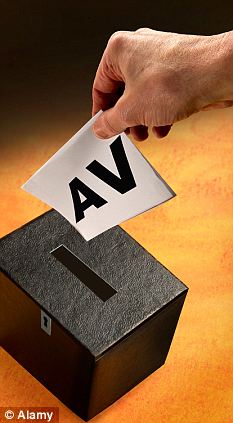
AV or AV ?

In the UK we are gearing up to vote on how we vote.
Yes – really – we are about to vote about how we elect our members of parliament.  If we vote ‘Yes’ our traditional ‘first past the post’ system will be replaced by AV – the Alternative Vote system where we will place 1 next to our first choice candidate, 2 next to our second choice and so on…
The ‘No’ campaign has been energetic in their objections to this new innovation.  It will be confusing, complicated and too difficult for ordinary people to understand.  And because it will be too difficult to understand, it will put ordinary people off voting at all.
But the bottom line for many in the No campaign is a simple unwillingness to embrace change.  They want things to stay the way they are, even if something new might just be better.
The irony is - there is another AV, which is much loved by people who like things to stay the way they always were – loved by the kind of people who hate change.   This AV is being celebrated this year for its 400th anniversary.   But this AV is genuinely confusing for some, difficult for most, and has a habit of putting people off.
This AV is, of course, the Authorised Version of the Bible – authorised that is, by King James in the year 1611.
Not surprisingly, the English language has changed a bit since then.  Words have changed.  Sentence structures have changed.  Nuances and idioms have changed.  The language is still beautiful to those who have learned to love it, but most people find it obscure, difficult to follow, and generally off-putting.
I remember a elderly member of a congregation who completely stunned me one day when she defended the Authorised Version saying, "I like to hear the words that Jesus actually spoke."  While few would be that confused, why not survey a few people around you to see if they know what these words mean:
‘Bewrayeth’       ( Matthew 26:73 )
‘Bolled’                ( Exodus 9:31 )  – no it doesn’t mean boiled!
‘Choler’                ( Daniel 8:7 )
‘Incontinent’     ( 2 Timothy 3:3 ) –  where incontinent people are a sign of the end times
‘The price of a dog’ ( Deuteronomy 23:18 )
‘Redound’           ( 2 Corinthians 4:15 )
‘Spikenard’         ( Song of Songs 1:12 )
‘Or in the woof’  ( Leviticus 13:49)

So how did you do?
Why do some people still insist on using the AV in church?  Perhaps it is because they want no-one else to understand – because they don’t want ordinary people to get involved.  Perhaps it is because if you can’t really understand the message, it can’t challenge you too deeply.
In the battle over AV, we do need to keep the message clear, not so much in our method of voting, but certainly in the Word of God.

Friday, 15 April 2011

This week's song is... 'Your love is a song' by Switchfoot


Keeping with the theme of God's love, from my last musical blog "My song is..."-  this song is a womderful expression of how God's dynamic love surrounds us and enfolds us.

Sometimes it is only after times of brokeness or disappointment that we become open to God is a new way - hence the lyric "I've got my mind/eyes wide open" which echoes through the verses.

In many ways it remids me of the beauty of Psalm 139:

Where can I go from your Spirit?

Where can I flee from your presence?
If I go up to the heavens, you are there;
if I make my bed in the depths, you are there.
If I rise on the wings of the dawn,
if I settle on the far side of the sea,
even there your hand will guide me,
your right hand will hold me fast.
If I say, “Surely the darkness will hide me
and the light become night around me,”
even the darkness will not be dark to you;
the night will shine like the day,
for darkness is as light to you.

For you created my inmost being;
you knit me together in my mother’s womb.
I praise you because I am fearfully and wonderfully made;
your works are wonderful,
I know that full well.
For those who haven't heard of Switchfoot before, they are a Chirstian band from the US and this is definately one of their quieter songs...
The first blog in the series was  My song is ...

Tuesday, 22 March 2011

Bible says No - Part 3 - Corinthians and Timothy

This is Part 3 in a series inspired by the 'Little Britain' sketch "Computer says No".  It seeks to challenge the perception that the Bible issues a blanket prohibition on same-sex relationships.
You can read Part 1 here, and Part 2 here.
The Apostle Paul has had quite a bad press in recent years.
As the Church has modernised its attitude to women, some of Paul’s statements have sounded antiquated, even prejudiced.  Not allowing women to speak in church is one example that stands out but there are others.  Protracted discussions about head-covering, and indeed headship seem a long way from the experience of many Christians today in an age of equality.   And that is before we grapple with other enigmatic verses about women being ‘saved by childbearing’!
In some places, this has resulted in some aversion to readings from the Epistles.  There have been services where I have almost heard a sharp intake of breath among the congregations when such passages are read in church.  The fact that orthodox theologians have felt the need to address this in recent years in books like “Did St Paul get Jesus Right?” shows how deeply this has been felt.
But to succumb to such a point of view is to underestimate and devalue Paul’s contribution to the New Testament in a way which is far from justified.  Alongside the few passages which seem to sit uncomfortably alongside modern understandings of society, there are a whole host of other areas where Paul’s radical and inclusive theology blaze a trail for which we should be profoundly grateful.
His uncompromising insistence of salvation through faith alone, freedom from the Law and life in the Spirit, are just some examples which are at the very heart of what it means to be a Christian.  His beautiful and universal description of love in 1 Corinthians 13, quoted by people of all faiths and none, deeply inspires us and moves us.
And on a deeply practical level, all men have cause to be deeply grateful to Paul for successfully opposing those who wanted to impose circumcision on male converts to Christ!
The secret to understanding Paul is to discern between theology and cultural practise.  Paul's theology is timeless and reveals to us in wonderful vivid ways the glory of God.  His cultural practise on the other hand, is focused within the culture of his day, the culture in which he lived.
The theology we find in Paul’s epistles is truly remarkable.   It is the theology of equality – in Christ there is no slave or free, no male or female, no Greek or Jew.  It is the theology of equal grace – it is by grace you have been saved, through faith, so that no one may boast.  It is the a theology that rejects the constraints of religious law in favour of being led  by the Spirit – the fruit of the Spirit is love, joy, peace…. against such things there can be no law.  It is the theology of growing in understanding, not religious repression - for now I see in part, I know in part, but then I will know fully, even as I am fully known.
We can only be inspired by the love and power of God at work in this most zealous of Pharisees, called while he was a persecutor of the church, and yet who, in God’s grace, became the Apostle to the Gentiles – those outside the people of God, who were dismissed and looked down on by God’s chosen race.
But alongside this, we also see Paul grappling with the cultural issues of his day, and the impact they had upon the new, fragile churches he was writing to.  He was writing to a world very different to the one which we observe today.  He was writing to a world which accepted slavery as a cultural norm, where spectators revelled in seeing death in the arena, and in which human rights were limited and dependant on political status. He wrote to fledgling Christian communities made up of Jews and Gentiles with very different norms and expectations about what was proper and socially acceptable.  He wrote in a world where the religious practises of the vast majority of the population would seem bizarre and alien to us today.
So in the midst of all these issues, he tried to set down norms which would enable these Christian churches to function and grow in the Roman world, and yet not be conformed to it.    This is where we find Paul's pronouncements on the role of women for example - statements that were motivated by considerations of cultural practise rather than expressions of the radical new theology of the Gospel.
He also lived in a world which he did not fully understand.  Although he was clearly an educated Jew and a Roman Citizen, his culture was set firmly in the Jewish world, and as he went further and further in his travels across Turkey, into Greece, and ultimately to Rome, we find him grappling with the subtleties of Greek faith and culture as well as Roman politics.
It is within this mix that we find the briefest statements in Romans, 1 Corinthians, and 1 Timothy which appear to address the issue of homosexuality.  Today we will look at the 1 Corinthians 6:9 and 1 Timothy 1:10.
The first thing to notice is that the word ‘homosexual’ did not exist in Paul’s day.  In fact it only begins to appear in the in English language in the 19th century.  The concept of homosexual orientation is one which is relatively new in human society.  There was certainly homosexual sex in the Greek world which Paul moved through, but that does not mean that monogamous, faithful, committed same-sex relationships were the norm.
Same-sex acts of various kinds existed in the Greek world between teachers and pupils, in the  military, in religious worship, and at the gymnasium.  Even today scholars find it a huge challenge to try to unravel their complexity and significance. 
But this is not the issue that Christians are grappling with today. 
The overwhelming majority of gay Christians today are not fighting for the right to indulge in promiscuous, religious, or hedonistic sex.  They simply want the church to recognise the same Christian ethic for them as for heterosexual couples, and increasingly want the same structures and sacraments to frame their relationships.  This would not have been what Paul saw as he journeyed through the Greco-Roman culture of his day.  What he would have been aware of, was the bewildering array of sexual activity which existed - much of which, as a Jew, he would have had little understanding of.
As a result, gay Christians have, for many years, said that they don’t recognise themselves in the things Paul writes about in respect to homosexuality (if indeed we can even call it that).  Put simply, the things that Paul condemned are not the things that LGBT Christians aspire to today.
On top of that, there are considerable problems in translating the words which Paul uses.  In 1 Corinthians 6:9 we find the verse, often quoted that says,
9 Do you not know that the wicked will not inherit the kingdom of God? Do not be deceived: Neither the sexually immoral nor idolaters nor adulterers nor male prostitutes nor homosexual offenders 10 nor thieves nor the greedy nor drunkards nor slanderers nor swindlers will inherit the kingdom of God.  (NIV, 1984)
But the words translated as ‘male prostitutes’ and ‘homosexual offenders’ are far from clear in the Greek which Paul wrote.  The two words are ‘malakoi’ and ‘arsenokoitai’.
Malakoi also appears in the Gospels.  In Matthew 11:8 and Luke 7:25 Jesus asks people what they expected to see when they went to John the Baptist. 
What did you go out to see? A man dressed in fine clothes? No, those who wear fine clothes are in kings' palaces.
The word translated as 'fine' is malakoi.  More usually it means 'soft' and was often used in Greek language to speak disparagingly about people who were soft willed, spineless, or lacking in courage.  In English translations, it was not until the 20th Century that malakoi was given a homosexual meaning.  What was more common before that, was the meaning found in John Wesley's Bible Notes.  He defines "malakoi" in 1 Corinthians, as those:
"Who live in an easy, indolent way; taking up no cross, enduring no hardship"

Arsenokoitai is even more difficult to unravel.  It does not appear in any contemporary Greek texts, and appears for the very first time in 1 Corinthians.  One tool in discerning the meaning of words is to observe how they are used in a variety of contexts.  In the case of arsenokoitai, we have no contemporary contexts outside of Paul's writings to compare.  The only other use of the word is in 1 Timothy 1:10, where it is translated in the NIV as 'perverts':

9 We also know that law is made not for the righteous but for lawbreakers and rebels, the ungodly and sinful, the unholy and irreligious; for those who kill their fathers or mothers, for murderers, 10 for adulterers and perverts, for slave traders and liars and perjurers—and for whatever else is contrary to the sound doctrine.

This lack of comparable examples to cross-reference has prompted many to ask how we can know for sure what Paul meant by it, and how can we translate it with any degree of certainty?

The most likely explanation is that Paul invented the word, by putting together two words from the Greek translation of Leviticus 18:22 which condemns someone 'who lies with a man as with a woman'.  But as we have seen previously, (Bible says No - Part 2) this condemnation was almost certainly linked to religious prostitution and worship of idols.  The command was designed to keep Israel separate from the dubious religious practices of the cultures around them, and free from idol worship.

This of course brings us back to what Paul saw in the Greco-Roman world.  He would have been aware of same-sex acts in the context of Greek religion, Greek education, Greek gymnasiums - in short 'Greek Culture' -  and he knew that the church must be kept pure from that in the same way that the holiness code of Leviticus was designed to keep Israel pure from the dubious practises and idol worship of those around them. 

So if we can have any degree of certainty about these words, it is that they condemned the Greek expression of same-sex acts , which are very different in context to that of gay men and women today, in loving, committed, faithful, exclusive same-sex relationships.

As we try to unravel 1 Cor 6:9 and 1 Tim 1:10, the case against homosexual relationships today becomes less and less clear.  The words Paul used are either unclear in their meaning, or are simply not found in other contemporary texts, inside or outside of scriptures.  Even Greek scholars find it hard to translate them with any degree of certainty.

I had always been told that ‘homosexual offenders’ in the Bible meant all homosexuals who had sex, regardless of the context, but I now find this impossible to justify.  There is a world of difference between a man and a woman having sex together in prostitution, as opposed to marriage, and we would never dream of treating those situations as comparable – so why do we assume that all homosexual sex is condemned in the Bible? 
If these verses can be translated in a way which condemns homosexual acts, then the acts they condemn are the wicked, immoral, idolatrous, adulterous expressions which the first part of 1 Corinthians 6:9 refers to - not the self-giving love that we observe today between people of the same sex who genuinely love each other and want to commit their lives to each other before God.
Next time - Romans 1 ...