Showing posts with label vocation. Show all posts

Tuesday, 30 October 2018

Broken Vessels


I have just agreed my retirement date with the Church of England.  It will be the 30th November.

This is not because I have reached retirement age of course.  I have been granted ill-health retirement as a result of my cancer.  Having been unable to work since I was in hospital in August and seeing no prospect of returning in any meaningful way, I put in my application for retirement soon afterwards.   My early retirement will also allow the Diocese to begin looking for my successor so all in all, it is the best solution. 

But it leaves me with an uneasy feeling deep in my bowels as intertwining strands of relief and sadness weave their way through my body and soul.

When I was first diagnosed, I decided that I would keep working for as long as possible.  “What else would I do?” was a phrase which I often used when asked, and I profoundly disliked the idea of just sitting at home waiting to die.  “I’m not giving up yet” was another mantra I employed which begs the question “Am I giving up now?”

From my diagnosis in August 2017, I continued to work full time until I started chemotherapy in the Autumn.  Even then I just took two days off around each chemo infusion and worked from home when I was most prone to infection.  It was still pretty full on.

As time went on though, things started to get more difficult.

Towards the end of my 5 months of chemotherapy, I found that I wasn’t recovering as quickly after each cycle and began working 10am-4pm each day.  A little later this had to reduce further to working Monday, Wednesday and Friday, allowing me days in between to rest and recover.  The one hour drive to and from the office also started to take its toll.

Then I began to notice that God was giving me hints.

The first came in February this year.  I was due to see me oncologist for results of a CT scan.  The results would show how successful my treatment had been so far.  Before we set off for the hospital, I settled down to my morning prayers with the appointment very much in mind.  When I got to the gospel reading in Celtic Daily Prayer, I found it was a single verse.

 “Lord you now let your servant depart in peace, according to your word, for my eyes have seen your salvation.” (Luke2:29)

These were the words spoken by the old prophet Simeon when he saw the baby Jesus and knew that God’s promise to him had been fulfilled.  Now he was ready to die in peace.

I was taken aback. What did this mean?  What was I about to be told? 

At the appointment I found that the scan results were mixed.  Some mets (tumours) had shrunk, some had grown and there were some new ones.  It wasn’t what my oncologist had hoped for but it wasn’t disastrous.  I knew it didn’t signal the end in my fight with cancer, so what was God trying to tell me?  Was there something else which was coming to an end?

The second hint was less subtle.  In July, I was on my way to celebrate Communion with a group of young people who were spending a year in the diocese exploring vocation.  It was always a joy to meet with them and a privilege to celebrate Communion, yet while driving there I felt so tired.  I prayed, “Lord, please, if you want me to keep working, I need some energy!”

At the end of Communion, I packed my communion set away as usual and set off for home, still feeling dreadfully tired.  At home I got the pottery pattern and chalice out to clean them properly only to find the chalice in pieces.  I had stored and carried it in the same way for years without any incident and yet somehow, this time, it had been broken.

As I held its broken pieces in my hands I felt immediately overwhelmed.  I knew what God was saying.  Central to the ministry of any priest is the celebration of Holy Communion.  It was time to let go.

Being a good Charismatic Evangelical however, I knew that I should never rush into anything, but wait for a third and final confirmation of this word to me.  I talked with my spiritual director and we agreed that I would wait to see what my oncologist said when we next met.

I didn’t have to wait long.  In August I was unexpectedly admitted to hospital feeling very poorly.  After yet another scan, my oncologist appeared at the bottom of my bed with the news that the treatment was not keeping pace with the development of my cancer.  Things would only get harder from now on.  I knew the time had come to set work aside.

Looking back, I had been preparing for it at work.  Over the last 12 months, I had been working to make my role more sustainable without me; putting together teams of people who could carry on the important work of identifying and encouraging people who God is calling to Christian ministry.  Some areas were now strong enough and ready, but others were not.  Couldn’t I have had a just few more months, to future-proof everything?

As I reflected on this, I have realised that it would always have felt this way.  It would never have felt that I had done enough so the feeling is irrelevant.  ““Lord you now let your servant depart in peace” is all I have to rely on, that God feels I have done enough.

And yet the sadness remains.  In the end it all feels very sudden.  I first felt God’s call to ordained ministry over 40 years ago when I was just 14 and being obedient to that call has been at the very centre of everything for me, and subsequently for myself, my wife, & family, ever since.  Now, suddenly, it is over.

After I found my broken chalice, my wife Mel suggested we repair it and told me about the Japanese art of Kintsugi where broken pottery is repaired using lacquer infused with gold, making the result much more beautiful and, indeed valuable.  I wasn’t in a place where I could hear this at the time.  The broken pieces went into the bin

I regret that now and wish I had listened to her (how many times do husbands say that?!)  God is in the business of binding up the broken after all, and bringing beauty out of brokenness.  I was too hasty with my chalice, perhaps because the truth its broken pieces revealed to me was too uncomfortable to accept at that time.

Broken Vessels by Leila Mather
But then in September, one of my friends shared on Facebook a piece of art which she had created.  Leila entitled it “Broken Vessels”.  I cannot guess at what she saw in her each element of her painting, but I know how it spoke to me.

The lines of gold in the chalice speak to me of a broken vessel restored in that ancient Japanese tradition.  Each one showing an element of brokenness and yet also celebrated and valued as the cup returns to useful service.  The dove is the Holy Spirit still descending on this broken cup with God’s blessing and anointing.  The blue lines around the dove’s head speak to me to the waters of life still flowing into the chalice, or flowing out to the world around it.

Perhaps God isn’t finished with me yet.

The Bible verse quoted in the painting reminds us that “We have this treasure in jars of clay to show that this all-surpassing power is from God and not from us.” (2 Corinthians 4:7)

My sadness comes from the realisation that I am a jar of clay, and one which is breaking a little more each day, but I can also be thankful for the treasure which God has placed inside.  My calling to be a priest continues of course, irrespective of whether I am working in the church or retired.  Perhaps God may yet have some things for me to do, broken as I am.

I retire from ministry on 30th November, but my calling carries on.


Saturday, 24 March 2018

ACCM!


Crossing the Line - part 19


While at university, my path towards ordination continued.

I met with my DDO (Diocesan Director of Ordinands) in Manchester when I was at home with Mum and Dad and in my second year, I was deemed ready for ACCM (see below for explanation!)

The Church of England selection conference for ordination is a strange animal with many names.  These days it is called a BAP – with apologies to friends in the Midlands and Northern England where this means something entirely different!  In the past it has also been CACTM and ABM.  In my day it was the Advisory Council for the Church’s Ministry (ACCM).  Whatever the name, it has changed little over the years.  It’s a three-day residential selection panel, that can feel like being in a human goldfish bowl.   As well as interviews with the selectors or advisors, there are group exercises and written pieces of work.  You are observed almost all of the time to see how you relate to others and express your faith and calling.  You are expected to sit at different tables each meal time to ensure that all the selectors get a good look at you.  The only times you are not being observed are in the regular acts of prayer and worship.  It’s a bit like a spiritual version of the TV series Big Brother, with Bishops Advisors instead of cameras.

Before I went however, there was still one thing on my mind that I needed to sort out.

At one of the university Christian Unions meetings I had heard a preacher called George Verwer.  He founded a missionary organisation called Operation Mobilisation (OM) in the 1950’s and was a compelling speaker.  He asked us what Jesus last commandment was, before he went back to heaven.

The answer is found in the final verses of Matthew’s Gospel.

“Go and make disciples of all nations, baptising them in the name of the Father and of the Son and of the Holy Spirit, and teaching them to obey everything I have commanded you. And surely, I am with you always, to the very end of the age.” (Matthew 28)

George argued that this last command calls on all Christians to be missionaries.  So the real question is not “Am I called to be a missionary?” but rather “Am I called to stay at home?”   His challenge went further, arguing that unless you hear God calling you to stay at home, your Christian duty is to go into all the world, because those were his last instructions.

This turned everything upside-down for me.  I had assumed that missionaries were the special few, called by God to a special task.  George Verwer was saying that we are all called to be missionaries unless God tells us otherwise.  I felt challenged and began to pray.  Was God indeed calling me to ordination in the Church of England or was he calling me overseas?  I needed to know.

The answer came from one of the few times that I have actually heard an audible voice.  One day at the end of my prayers I heard the words, “Read Ezekiel 3.”  That was it.  No burning bush or blinding light.  No clap of thunder or vision of heaven.  Just a simple instruction to read this chapter of an Old Testament book about the prophet Ezekiel.

As I opened my Bible, I had no idea what I would find.  It was not a book or chapter I knew well and although I must have read it at some point, I couldn’t remember anything about it.  I was, therefore, utterly amazed by what I found there. 

“Son of man, go now to the people of Israel and speak my words to them. You are not being sent to a people of obscure speech and strange language, but to the people of Israel – not to many peoples of obscure speech and strange language, whose words you cannot understand. Surely if I had sent you to them, they would have listened to you.  But the people of Israel are not willing to listen to you because they are not willing to listen to me, for all the Israelites are hardened and obstinate.  But I will make you as unyielding and hardened as they are.  I will make your forehead like the hardest stone, harder than flint. Do not be afraid of them or terrified by them, though they are a rebellious people.” (Ezekiel 3:4-9)

 It is part of the story of God calling Ezekiel to ministry.  Chapters 1 & 2 set the scene and in chapter 3 was the answer to my question.  There was no ambiguity – it was in black and white in front of me!  I couldn’t believe it.   As I read and re-read the chapter I realised that just as Ezekiel was called to his own people (the people of Israel) so God was calling me to my own people.  The realisation also came to me that this would not be an easy task.  “If I sent you to great nations that spoke difficult languages you didn’t understand… they would listen to you… but your own people will not listen.”  I wasn’t sure what this meant yet, but one thing I knew for sure – God was calling me to stay.

So early one March morning in 1984 I set off for my ACCM.  It was a long journey.  I had to travel from Oxford to Riding Mill in Northumberland.  It took 3 trains, the tube, and a 15-minute walk from the station at the other end to get to the retreat house.

The only preparation I received for my selection conference was the instruction “Go and be yourself lad, you’ll be fine.”  Compared with the way Dioceses prepare people for their selection conference today, that was decidedly minimalist!  So I went as myself, dressed in jeans, trainers, T-shirt and denim jacket, with my Adidas bag slung over my shoulder.

On the last train from Newcastle I noticed someone smartly dressed in his three-piece suit & tie and with his professional looking suitcase.  When I got off at Riding Mill Station he got off too, and started walking up the road to the retreat centre.  When I followed, I sensed him getting a little nervous at being followed up these deserted country lanes by a denim-clad stranger.  He started to quicken his pace and I thought of trying to catch up with him, as I was sure we were both heading for the same place.  Then I thought better of it.  If he was scared now, what would he be like if I started to run after him.  I slowed my pace to allow him to get away!

On arriving at the retreat centre I was looking at the visitors’ book and working out how to register, when I heard a voice saying, “Are you just leaving?”  I turned around and saw another smartly dressed man who had clearly taken one look at me and thought I couldn’t possibly be a potential ordinand.  What a welcome!  He turned out to be another of the candidates, not one of the selectors, but I couldn’t help feeling a bit out of place.

If I am honest though, it didn’t really bother me.  It may sound arrogant, but I knew God was calling me to be a priest, right down to the depth of my being.  I know that not everyone feels that way.  Many go with a much more questioning approach, wanting to test if this is for them, but I knew.  As a result, I wasn’t worried about getting a ‘No’ at the end.  If that happened it was the selectors who would have made a mistake, not me.  I would simply wait the statutory two years before I could try again.  Although this may seem arrogant, it wasn’t.  I didn’t think that I was God’s gift to the church.  I knew my weaknesses far too well for that.  I just knew, despite all my faults and failings, that this was God calling for me.

As the three days progressed I noticed that the other candidates did progressively dress down and if I am honest, I dressed a little smarter, putting a proper shirt over my T-shirt!  We almost ended up meeting in the middle.

The selectors were astute but kind, and they did their best to put us all at our ease.  My interviews went well, although I was a little disturbed by my educational interview because it was far too short.  Almost as soon as I walked through the door, the selector told me, “You’ll be alright; you’re at Oxford” and to all intents and purposes that was the interview.  While reassured to hear I would be ‘alright’, I did wonder if that was a little presumptuous.  Maths and Theology are miles apart and I hadn’t written essays since I was 16.  How had he come to this conclusion without asking me a single question?  It partly stuck in my throat because in those days, the only selector with a veto on recommending a candidate for ordination was the educational selector.   I wondered whether he gave a much harder time to candidates who had not been to Oxford.  It all felt a bit too elitist and cosy to me.

The two other things which stick in my mind about my ACCM Conference were nudity and drinking!

There was a group exercise called 10 minute topics.  Our names were drawn out of a hat at random and we each had to choose card from the coffee table in the middle of the room.  The cards were face-down and when you turned over your chosen card, you read the topic you had been given.  We then had 10 minutes to introduce the subject, then chair a group discussion and sum up at the end.

At 21, I was by far the youngest person in the room, and my name came out of the hat first.  I approached the table, chose a card and turned it over.  It read “Beach nudity – harmless fun or moral outrage?”  I almost burst out laughing.  Looking around the more elderly group I was in, I took a deep breath and launched into the subject.  Why couldn’t I have got one of the easy topics like fox hunting, pacifism, or euthanasia?!

Outlining arguments from each point of view, I opened it up for discussion.  Silence.   It was like trying to get blood out of a stone or discuss nudity at a Church Council meeting.  Half of the room were too embarrassed to speak and the other half were worried about saying something which would place them in a negative light with the selectors – either too judgemental or too permissive.

After a bit of encouragement, one brave soul opened his mouth and began with the words, “When I was in the south of France…”  Thank you God!  Then others chipped in and it went well in the end.

The other memory I have is from the second evening.  We had been told by the selectors that attendance at Compline (night prayers) was optional and we could choose whether to attend or not.  So on the second day, a small group of us took the selectors at their word, missed Compline and went to the pub instead.  After we ordered our drinks and sat down, we noticed one of the selectors was also in the pub, sitting at another table. Was he having some time out too, or was he there to spy on us?  Initially we all felt like we were back at school and had been caught sneaking out, but then we relaxed and enjoyed our evening.  We did swap contact details and promised to let each other know if got through of not – a kind of straw poll on whether nipping down to the pub was seen as a black mark at selection conferences.

The three days came to an end and we all went our separate ways, knowing that the decisions lay with the selectors’ now.

During the long journey back to Oxford I couldn’t believe how tired I felt.  I was exhausted and more than that, a kind of depression set in.  As the adrenaline levels fell away, far from feeling close to God and eager to know if my vocation had been recognised, I felt down, exhausted and alone. 

Working as I do now in encouraging Vocations, I now know that this is common among people who go to BAPs today (Bishops Advisory Panels) but I think it is still underestimated.  Parish priests and supportive friends would do well to know that most candidates will need more encouragement after a BAP than before it. Candidates also need to know what to expect and be allowed to cut themselves a little slack after attending one.

About ten days later the phone call came from my DDO.  I had been warmly recommended with two conditions; that I finish my degree at university, and that I didn’t go to theological college straight from university.  I should spend at least a year doing something different first.

I was over the moon!  It was 5 years since I had first filled in a form to explore ordination and now I had been recommended for training.  I also welcomed the time out before theological college with open arms, having already decided that there were lots of exciting things that I would like to do.  My mind went back to my father who was told the same thing after his selection conference.  It was suggested that he should go and work in a book shop, but instead got himself a job on the shop-floor of a steel works.  What would I do?

With my parents in 1984
Telling my parents was a particular joy.  They had always been very careful not to influence me in any way.  Ever since I told them at 16, they had been totally neutral and had never expressed an opinion, for or against.  Now, as I told them my result, they were openly overjoyed and finally told me they thought God was calling me to ordination all along.

When our little group from the pub let each other know our outcomes, guess what?  We had all been recommended.  In the end, neither beach nudity nor drinking had been a barrier to any of our callings being recognised – perhaps they even helped!


Sunday, 11 February 2018

Moving on

Crossing the Line - part 14


As sixth form progressed, I had to decide what to do next.

In one way this was easy.  I wanted to go to university.   When I was about 15, I had made the audacious statement that I wanted to go to Cambridge.  I say audacious because I had only just made it off the bottom of my class into the dizzying heights of mediocrity at the time.  Somehow, my teacher managed not to burst out laughing and told me that if I worked hard, why not?

I only said Cambridge because we had visited it on a family holiday.  The rarefied atmosphere of the colleges won me over, from the grand to the quaint.  The thought of living in one of these ‘other worldly’ quads captured my imagination.

This was all fine until I mentioned it to Lesley who was my girlfriend at the time, and she said, “But I want to go to Oxford.”   So when I saw a young vocations weekend advertised at Jesus College Oxford, I knew I had to go.  What a great opportunity to kill two birds with one stone – I could go to a weekend about ordination and see Oxford properly at the same time. 

Two things stood out for me over the weekend. 

First was the morning I spent with the chaplain at Oxford prison.  It was a time of extreme overcrowding in British prisons and the sight of Victorian cells designed for one or two prisoners, but crammed with up to four inmates was shocking.  There was so little space that if anyone needed to get to the cell door, the others had to jump on their beds to allow him through.  It was also in the days of slopping out where the toilet consisted of a bucket with a towel over it, which was slopped out each morning before breakfast.  The smell must have been unbearable at times.

Second was an afternoon wandering about the colleges of Oxford.  I decided that I would walk around as many as I could and see if any of them ‘felt right’.  This was not a very scientific approach for someone looking for somewhere to study maths, but as I have since discovered there is an intuitive side to my personality which sometimes has the upper hand. As I walked around the colleges, I came to a very definite decision that there was one which felt right.  Brasenose College was a smallish college on Radcliffe Square and as I walked around I could imagine myself living and studying there.

So I came back to Bolton and told Lesley the good news that I had decided to apply to Oxford – except that when it came to filling in our applications, Lesley applied to Cambridge!  Perhaps there was something she was trying to tell me?  Our relationship actually lasted over 3 years, ending during the summer holidays just after A levels.  It was a happy time and through lots of ups and downs we made it work – a romantic relationship between two Christians which helped us both to grow without falling into the usual teenage pitfalls.  Lesley applied to Cambridge, and I applied to Oxford.

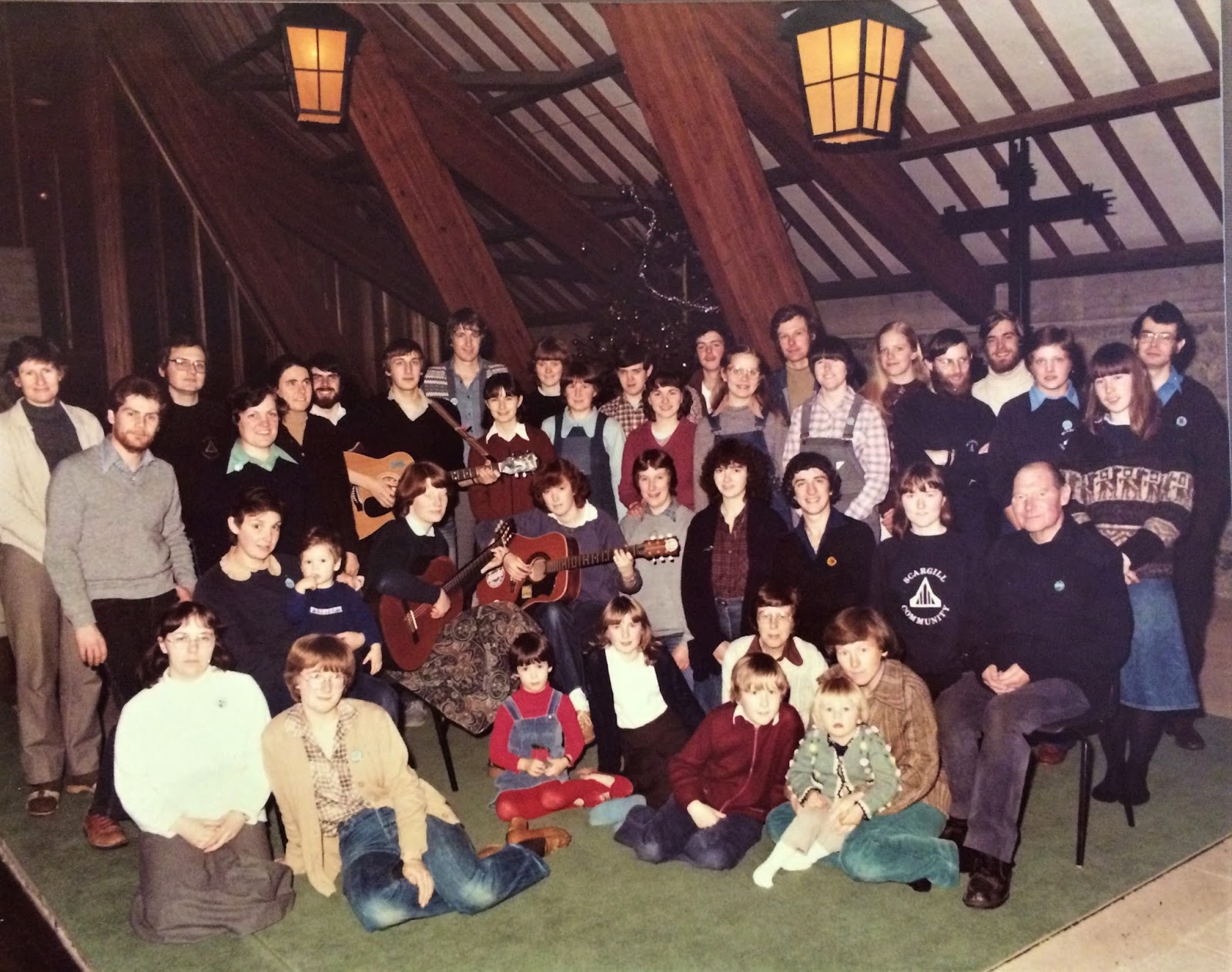
Then came the question of what to do with the time I would have off between the Oxbridge exams in November and starting university the following Autumn (wherever that might be).  During childhood, another place we had visited often was Scargill House in the Yorkshire Dales.  Set in the picturesque landscape of Upper Warfdale, Scargill was a Christian community of about 30 people who ran a conference, holiday, and retreat centre for about 90 guests.


 For most people the words ‘Christian community’ bring visions of pious looking monks or nuns in religious habits, but Scargill was nothing like that.  Most of the community at Scargill were in their 20’s and wore jeans not habits.  When a member of the community was invited onto local radio to try to explain what it was like to live in community, he began by saying, “We do everything together; we work together, we eat together, we...” and everyone wondered what he was going to say next!  Thankfully he finished the sentence with “We pray together.”  This religious community was predominantly a group of young people who chose to live there for a time to find out more about themselves and deepen their faith, joining for anything from a few months to a several years.

Scargill Community 1982

 We certainly worked together and looking after the guests involved cooking, cleaning, as well as managing the 96-acre estate under the leadership of a Chaplaincy Team.  We also took turns to be on the Guest Team, leading whatever conference, retreat or holiday was on the programme for that week.  This involved making everyone feel at home, leading worship, drama or meditations, and accompanying our guests on walks around the Dales.

Scargill has the most beautiful modern chapel which somehow set the ethos for the whole place.  It is in the shape of praying hands under a huge wood shingle roof.  We sat around the altar on its large stone dais which doubled as a place to kneel for communion or as a stage for drama or dance.  Each end of the chapel was completely glazed in clear glass, revealing the beauty of God’s creation with views of across the dale or up into the forest behind.  Every morning we would meet there for prayers after an early breakfast.  It set the scene for the day.


I applied with excitement and got an interview.  It was the week after Easter and I borrowed my parents’ motor caravan to drive up in.  As I set off from Bolton it started to snow.  By the time I reached the Yorkshire Dales it was a blizzard.  The last 15 miles from Skipton to Kettlewell were going to be a real challenge, and one which proved too much.  I finally gave up when the snow plough I was following stopped because the snow drifts were too deep.  Returning to Skipton, I phoned Scargill in bitter disappointment, only to be told, “Don’t worry, we’ll pick you up!”

Sure enough, about 40 minutes later a land rover arrived driven by a member of the community who was an ex-royal marine commando.  I quickly learned that his strategy for snow drifts was simple; the bigger the drift, the faster you drive at it!  We arrived in one piece just in time to find that the power had gone out and there were 70 guests to look after.  It was an eventful weekend with the snow 2-3 feet deep in places.  After managing on emergency power overnight, the electricity came back on in the early hours of the morning and I spent most of the weekend in a team shovelling snow from the long driveway to make sure our guests could leave.

So it was that I was offered a place on the community and immediately after my Oxbridge exams, I left home on a new adventure.

Of course, nothing is ever what you expect it to be.  For me, the most important lesson of going to Scargill was to begin at the bottom again.  I left my church in Bolton and the youth group where everybody knew me and often looked to me for advice and leadership.  I arrived at Scargill where nobody knew me, and I didn’t know them.  The first week was spent washing up.  The second week, I was moved to House Team who cleaned the house from top to bottom every day.  Any romantic notions of the joys of living in community are quickly dashed when you are sent off to clean the 30 or so toilets around the house before 11am!  Then there was changeover day, when one group of guests left and another group arrived.  Every bed in 50 rooms needed changing, before cleaning and setting up just right for the new arrivals.  It was hard work and there was a ‘Scargill way’ of doing everything, from folding the sheets to arranging the furniture in the large meeting rooms.

Looking back, I learned there what it really means to serve people in Christian ministry.  Not up the front with everyone looking at you, like being a priest at the front of a church, but in the simple unseen acts of service which no one notices, except if they are not done – like cleaning toilets.  It was a good lesson for me to learn.

A few weeks after I arrived at Scargill, I had to go to Oxford for interview.  It was another cold and snowy few days, trudging through the snow from college to college for interviews.  When I looked at the other candidates I didn’t think I stood a chance.  There were only 6 places for Maths at Brasenose and there were 12 of us there.  All of them appeared to be much smarter than me.  At one interview, after we had talked about maths for a while, I remember being asked about my application.

He showed me two consecutive lines on the application form.  The first asked for my chosen subject – mathematics. The second asked what career I wanted to follow, and I had written “Priest in the Church of England”.  He looked puzzled and said, “So you don’t want to do anything with your maths after you finish then” quickly followed up by “So why do you want to study maths?”

I remember saying that I enjoyed maths and didn’t want to be the kind of vicar who didn’t know about anything apart from theology.  He smiled.

Looking back, I am sure that this question got me a place at Brasenose.  It was the only thing which set me apart from other applicants, the only thing which would have been memorable when the time came to choose who to offer a place to.  I think it was just after Christmas that I got the letter inviting me to Brasenose College Oxford.  It took me a while to really believe it.

The time at Scargill passed all too quickly.  As I got used to the work there it became more and more fun.  I shared rooms with Simon who was mad about pot-holing and climbing, even taking me down the wet and slippery Providence Pot on one occasion.    As a community we welcomed everyone from Bishops to borstal boys.  Music, art and drama were a normal part of our weekly activities alongside cleaning the house, day in, day out. I even got used to the ‘Scargill way’ of doing things.

During one summer house-party when I was on the Guest Team, we organised a cross between ‘It’s a Knockout’ and a commando course around the estate complete with being drenched by fire hoses and a zip-wire ride!  Everyone had to complete the course in pairs and it started with a three-legged race, tied up with strips of old pillowcases.  “Keep hold of the pillowcases when you untie your legs” I said, “You may need them to staunch the blood later!” - trying to add to the excitement.  Imagine my face then the guest speaker for the week arrived at the finish line needing several stitches with blood dripping from the old pillow case wrapped around his arm!

I did start to think that Scargill would be the place I would end up, but then some of my youth group from Bolton came to visit and said “No – you need to be out in the world.”  So in September 1982, I left for Oxford with something of a heavy heart.  It was like finding somewhere you felt you belonged, but then knowing you have to move on.


Scargill became somewhere I went back to many times.  The chapel there became the place where I would return when I really needed to hear from God.  In the stillness, enveloped in those praying hands, surrounded by the beauty and majesty of creation, I always knew I would meet God there. 

It is some years now since I last went back, but I hope to visit again soon. 

You never know, perhaps I will hear something new?


Sunday, 21 January 2018

Gotcha!

Crossing the Line - part 12


It was also in my early teens that I first sensed that God was calling me to be a priest.

Soon after I was Baptised in the Holy Spirit, I began to get the strangest sensation.  It was like someone tapping me on the shoulder and I silent voice almost whispering, ‘I want you to do that’.  It happened in church during the communion prayer, or the sermon.  It happened when I read the Bible and came across the story of someone being called by God.  It happened in my prayer life when I was thinking about the future.

There was only one problem.  I didn’t want to do it.

When I was little there was a time when, like lots of other boys, I wanted to do what my dad did. By the time I had reached the grand old age of seven however, being ordained was the last thing in the world I wanted to do.  I had seen how hard my father worked and the uncompromising grief he was given by some members of the church.  I had seen the strain that put on my parents’ marriage and on us as a family.  I had seen how little he got paid and lived through the winters in a house we could not afford to heat.  All these things had brought me to the very definite decision that it would be the very last thing I would ever do.

The tapping on my shoulder was not welcome.  The silent whisper was not welcome.  So the response I gave to God was plain and simple.  It was a definite “No!”.

I started to search around for what I might want to do with my life.

First, I was going to be a lawyer.  I was good with words and could be quite persuasive in arguments.  Lawyers get lots of money.  That will do nicely.  But as I thought more deeply, I found things I couldn’t reconcile.  How could I defend someone who I knew was guilty?  While I knew that our legal system requires defence for everyone, I knew I couldn’t do it.  What would I do if I was being asked to help a client exploit loopholes against the spirit of the law?  I soon realised it wasn’t me too.

Then I wanted to join the RAF.  I went to see the recruiting officer who came each year to our school but then the thought of civilian casualties from indiscriminate bombing or human error became something I was not willing to live with.

I wanted to be an engineer.  Making things that improve the world we live in.  I lived with this idea for a while but I couldn’t get excited enough to be sure I could spend my life doing that.

And so it went on.  Lunchtime after lunchtime in the school’s careers room trying to find the thing which fitted my gifts, personality, principles – and which I would enjoy doing.  In the background, all the time, was this tapping on the shoulder and my very firm answer – No!

The argument went on for 2 years.

God:  I want you to do this…
Me:  No!
  
Then one Saturday, I remember that I went with my parents to a Day of Renewal in Manchester.  I even remember the church where it was held – Church of the Holy Family, Failsworth.

The day was a wonderful celebration of faith.  It was so life giving, so real, so inspiring, that in the back of the car on the way home, I started to have a conversation with God in my head.  It went something like this:

Me:  Oh God, I really want to tell people about how wonderful you are; about your amazing blessings are and how good it is to be a Christian.
  
God: … silence…

Me:  But Lord, it’s so difficult to tell people about you.  At school I get ridiculed because of my faith.  People who were friends don’t want to know, and I’m not brave enough to talk to strangers.  It’s so hard.

God: … silence…

Me:  I know… if I got ordained and wore a dog collar, it would be easy – because everyone would expect me to talk about you!

As soon as I had said this, I realised what I had said!  I immediately started backtracking…

Me:  Oh no, God.  I didn’t mean that.  Don’t get any ideas now…

What followed was remarkable.  It is one of the very few times in my life that I believe I actually heard the audible voice of God.  The first thing I heard, in the back of my parents’ car, was a chuckle.  An audible laugh which only I heard.  Not a laugh that was patronising or dismissive, but a gentle, warm chuckle.   

Then I heard God speak just one word to me…
  
God:  Gotcha!

... and I as sat in the car, on the way back to Blackrod, I knew that he had. 

There was no getting away from it.  I knew that all my protests and arguments were useless.  They had been as effective as King Canute by the sea, telling the tide not to come in.

I didn’t make any big public statement.  In fact, I didn’t tell anybody for quite some time, but I knew deep down in my heart that God had indeed got me.  The tapping on the shoulder continued, except now I didn’t say no. Instead, I asked God how?  And as I lived with this sense of calling, as my defensiveness melted away, I found myself realising that this did indeed fit.  It fitted my gifts, my personality & my principles and as I began to embrace this call, I realised that it was the only path in life which I would genuinely enjoy.


So when I was 16 years old, I filled in my first form for Manchester Diocese, asking to explore ordination.  I remember looking at the completed form thinking that my handwriting looked terrible. I didn’t know if I’d even answered the questions properly, as they were designed for someone much older and wiser than me but I had done it, and from that day onward, I knew this would be my life.

As reflect on this now, in the light of my recent diagnosis, and recognising that my life is going to be much shorter that I had expected, I am so glad that I said ‘yes’ all those years ago.  I am so pleased that I didn’t keep arguing, or put it on the back burner, or file it away marked ‘maybe one day’. 

Following God’s call has led me to the most amazing, challenging, times and places.  I wouldn’t trade it for anything.  I am so happy that I heard God chuckle and heard that immortal word…


Friday, 2 September 2016

Shylvia Shishons, Shpinshter of the Parish of Shaint Shwithens

Following the recent death of my father, I would like to share this short reflection on his early life.  He was an unlikely priest, brought up in a largely unchurched working class family in the 1930's and 40's he overcame considerable odds to follow God's call, and ultimately, he inspired me to listen to God's calling in my own life.

Below is a piece I wrote some time ago.  I guess now is the time to publish it...


David didn’t have a good start to his life.  A few weeks after his birth in 1932, his mother died of complications from the delivery.  His father John was heartbroken.  He had lost most of his friends in the trenches of the First World War and was already a man of few words, but now he retreated further into himself, which left Granny to bring David up.

She was a formidable woman who ruled the household with absolute authority.  She was one of those strong working class Lancastrian women who had a matriarchal power which defied any gender stereotype.  And she was, to all intents and purposes, David’s mum.

They were a proud working class family living in a terrace house in Bolton, Lancashire together with their extended family.  David’s father was a tram driver by day and built wooden model yachts and radios in the evenings.

Things didn’t get any easier for David either.  When he was two, he developed a severe ear infection and was taken into hospital.  In the days before antibiotics, they were soon told that there was nothing that could be done and he was likely to die.  Granny however, was having none of it.  When the doctors had given up on him, she took him home against medical advice, and in a supreme act of will, nursed him back to life.

The trauma of the illness took its toll however. His hearing loss was substantial and lifelong.  He didn’t speak again until he was 4 years old.   When he did start to speak he had a speech impediment and would say ‘Sh’ instead of ‘S’ – something which continued into adult life.

Anyone else would have simply been happy that he could speak again, but Granny didn’t give up there, pushing him into school and through school, believing in him no matter what.

When he was 11, she made sure that he was given a place at the Church Institute (now Canon Slade School) and he began to attend Bolton Parish Church.  This was his first encounter with the Church, and it planted many seeds which would grow later.  He sang in the choir but also loved the snooker halls opposite his school which resulted in him having to re-sit his A-levels before being offered a place at Liverpool University to study Physics.  Coming from a working class family in Lancashire, he was the first in his family to even dream of going to University, and Granny must have been so proud.  Her hard work had paid off.

It was in Liverpool that his faith grew and developed at the Parish Church - Our Lady and St Nicholas.   He discovered the ritual and spirituality of the Anglo-Catholic tradition.  When a visiting preacher said, “The question is not ‘Should you be ordained?’ but rather ‘Why shouldn’t you?’” David knew God was calling him to be a priest.

In his final year at University, he went to a selection conference, where his vocation to the priesthood was confirmed, but he was thought to be too much of a ‘narrow minded scientist’ to go straight to theological college.  He was told to go and spend a year ‘broadening his mind’.  Working in a bookshop was suggested to him but here David’s rebellious side kicked in.  Instead of finding a nice comfortable bookshop in which to while away a year, he moved to Sheffield, joined the Industrial Mission and got a manual job on the shop floor in one of the city’s huge steelworks.  There in the noise and heat of heavy industry, he worked at living out his faith and calling at the sharp end of working life.

His mind was broadened in more ways than one.   Despite wondering if he was called to a celibate life, he met Irene there.  They had a lot in common – they were both form working class households – both their lives had been touched by a deeply rooted Anglo-Catholic vision of Christian faith which embraced everyone in a deeply incarnational pattern of life – and both felt called to the religious life.  Irene had been a novice at the Convent of St Mary the Virgin in Wantage, and about to take her final vows when she had to return to Sheffield to care for her sick mother.  Her illness lasted for some years and Irene never did realise her dream of returning to the convent for life.

At the end of his time in Sheffield, David went to St Stephen’s House in Oxford (affectionately known as ‘Staggers’) to train for ordination but Irene was never far from his thoughts.  

David & Irene's Wedding
One Wednesday in his second year, he went to Arthur Couratin - his formidable college principal - and said “Irene is going into hospital in Sheffield for an operation and I need to marry her straight away.”  In the heavily cloistered, exclusively male environment of St Stephen’s House, he was more than a little surprised when Arthur said “Well you better go and marry her then!”  As far as we can tell, he was the first ever student to marry during training at Staggers.

David phoned her on Thursday – having already arranged a special licence for the wedding - to tell Irene that they “were going to be married on Saturday – and could she get a wedding cake?”  On Friday morning, Irene walked into Walsh’s - the big department store in Sheffield - to order the cake.  When she was asked for the date of the wedding she said “tomorrow” which caused more than a little shock, but after checking with the bakery, they accepted the order as long as she realised that the icing might still be a little wet.

After the wedding, they were apart once more as David returned to Oxford.  Women were treated with great suspicion at St Stephen’s House in those days – unless you were the principal’s sisters who acted as chaperone on the few occasions when Irene was allowed to visit.  Even though they were now married, Irene was only allowed to see David in the presence of Arthur’s sisters and was not allowed to stay at the college - having to sleep in a convent down the road instead.

David's Ordination as Priest
On 16th June 1957, David was ordained deacon in Sheffield Cathedral, and went with Irene to Arbourthorne where he was to serve his curacy.  It was a large social housing estate on the outskirts of Sheffield.  David’s ordained ministry had begun.

On his first Sunday, David was asked to read the Banns of Marriage in the service.  He picked up the book and to his horror, he found that he had to read the Banns for “Silvia Sissons, spinster of the parish of St Swithens”.   The speech impediment from his childhood had been an issue all his life.  He had received speech therapy at theological college, but this was a test that few would relish.


Amazingly he read the Banns perfectly.  The 4-year-old boy from a working class terrace house who could hardly speak – and yet had become the first in his family to go to University and had followed God’s call to ordination – found that the God who had called him would not let him down.